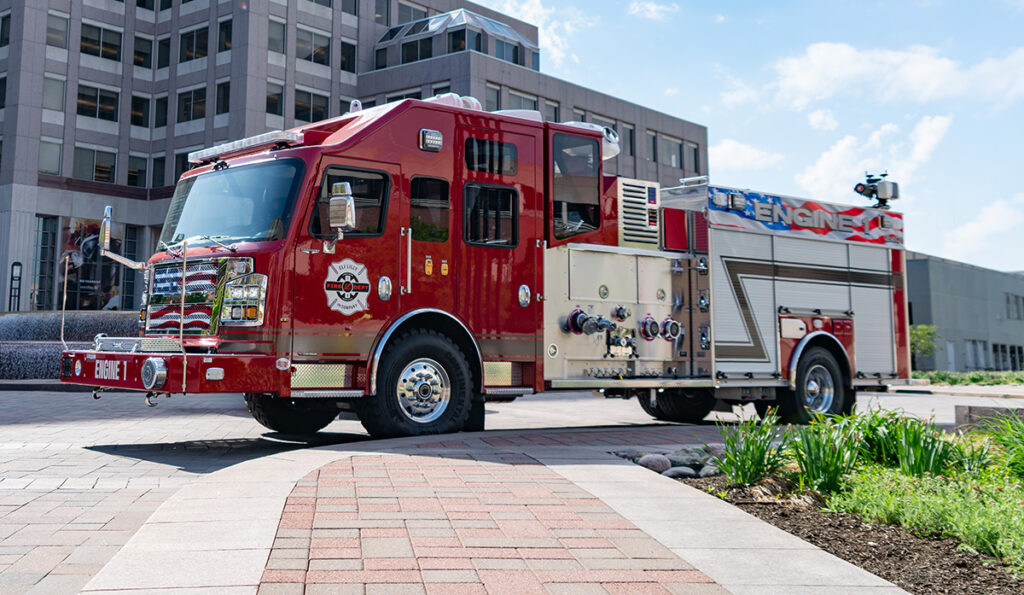
When Protection Means Everything
Rosenbauer · Custom Fire Chassis

Custom Chassis

Commander & Warrior — World-Class Custom Fire Chassis

The custom cab-and-chassis under Rosenbauer’s toughest apparatus — engineered from a clean sheet for fire service, crash-tested, and assembled in the USA. Cummins power, seating for up to ten, and a cab built entirely around your crew. Also available as the value-focused Warrior.

At a glance

Built from a clean sheet

Two purpose-built custom fire chassis — the flagship Commander and the value-focused Warrior — sized to your crew, your mission and your station.

Commander & Warrior — Custom Fire Chassis
Chassis
Two options
Commander & Warrior
Engine
Cummins
X10 to X15
Cab
Custom
Four to seven sizes
Assembled
Wyoming, MN
Rosenbauer Motors
Bare chassis / cab photo Bare Commander cab structure
The bare cab structure — before a single body panel.
Commanders built since 2012
—
Proven in service

On the road since 2012 — a purpose-built fire chassis with a long, proven track record under the country’s toughest apparatus.

Photo 1 Aerials
Aerials
Photo 2 Warrior Custom Pumper
Warrior Custom Pumper
Photo 3 Commander in service
Commander in service
Overview

A cab built around the crew

Commander is Rosenbauer’s flagship custom fire chassis — a purpose-built cab and frame engineered from a clean sheet for the fire service, not adapted from a commercial truck.

Every decision behind it started with two questions: what keeps the crew safe, and what keeps the truck affordable to own for the next twenty years. The sections below walk through how it answers both — the crash structure, the crew ergonomics, and the off-the-shelf parts you’ll actually service.

Configure yours
Spec your Commander

Tell us the apparatus, your crew size and your station’s limits. We’ll configure the cab, roof, engine and axles to match — and back it with local Heiman service.

Request a quote
Engineered customer-first

Answers to what departments actually asked for

Other OEMs lead with a smooth ride. Rosenbauer led with what actually costs departments money and gets crews hurt. They sat down with departments across the country running competitor apparatus, heard the same frustrations over and over, and built the Commander — and then the Warrior — as the answers. The big ones:

1
No proprietary parts
No branded electrical box, no branded suspension, no branded fluids. Repair parts — right down to the electrical and the IFS — were chosen so they’re available at national parts stores, not locked to one supplier, a dealer markup, or a long-lead factory order.
2
Galvanized subframe standard
Hot-dip galvanizing isn’t pretty — but it seals the steel against corrosion, the leading cause of chassis failure, where a painted frame just chips and rusts through. It’s standard on the subframe, and hot-dipped galvanized frame rails are available with a 20-year corrosion warranty — on top of the life-time frame warranty.
3
It ran the crush test out of weights
Third-party SAE J2422 roof-crush testing required 24,130 lb; the Commander cab held 120,000 lb — nearly five times the requirement, and so much load the facility ran out of weight. Front-impact J2420 came in at 2.27× the requirement. That’s the structure protecting your crew in a rollover.
4
The most crew space in the industry
The engine sits lower and rearward on a drop frame, so the engine tunnel inside the cab is only 21″ high with tapered 42″ corners — best-in-class. Your hips sit above the tunnel sides, with room to turn and talk to the crew, for a firefighter of any size in full turnout gear.
5
Doors that open to 85°
The cab doors open to 85° — the widest in the industry — on hidden heavy-duty stainless hinges, so you get out easily in full turnout gear with an SCBA on your back, not squeezing through a gap designed on a drawing.
6
One-piece windshield
No center post — and no distorted corner views. A clean, uninterrupted line of sight to the road and the scene.
7
Composite wrap-around dash
An automotive-style, wrap-around composite dash. Instead of feeling like you’re perched on top of the steering wheel, you sit behind the dash — the way you would in a car.
8
Flat rear floor
A flat crew floor with no PTO hump to trip over climbing in and out — safer footing for a crew moving fast in gear.
9
Best-in-class HVAC
Integrated automotive-style HVAC you can actually aim — 96,000 BTU A/C (110°→70° in 30 min), 82,000 BTU cab heat and 3,160 CFM of crew air — conditioning every seat, not just the front, with no view-blocking overhead unit.
10
Front fluid checks — no cab tilt
Check and top off your fluids without raising the whole cab. The front grille section is easily removable for quick access — a routine daily check takes a minute, not a production.
The part the sticker price doesn’t show

Buy the truck, not the badge

Let’s be honest about how a lot of these decisions get made. A recognized name on the door carries pride, and a shiny flagship rig looks good in the photo at the council meeting — that pull is real, and every one of us has felt it. But pride and image are an emotion, and emotion is a big part of what the premium is actually buying. The badge doesn’t pump more water, stop the truck shorter, or add a single year to the frame. Durability lives in the engineering and the metal — not in the paint or the name.

And that premium isn’t coming out of your pocket — it’s the city’s money and the taxpayers’. Speccing the truck that does the same job, protects the same crew and lasts as long for less isn’t settling — it’s the more responsible call. The Commander gives you the same capability — including independent front suspension — on off-the-shelf, brand-name parts you can service anywhere, a galvanized subframe and a corrosion-protected frame. Same ride, same protection, far less locked to one supplier for twenty years — and a budget you can defend line by line.

Two custom chassis

Commander or Warrior

Rosenbauer builds two custom fire chassis — both purpose-built for the fire service and both assembled at Rosenbauer Motors in Wyoming, MN. Pick the flagship, or the value-focused sibling.
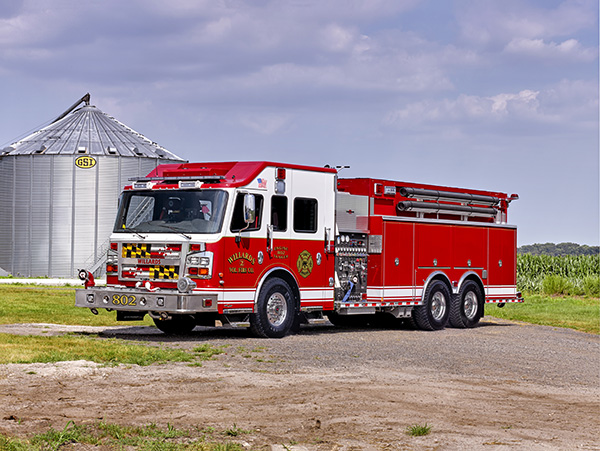
Photo — Commander Rosenbauer Commander
Flagship · Full custom
Commander

The top-of-the-line custom chassis — the widest range of cabs, roofs, engines and axles, and every option detailed on this page.

  • Widest cab, roof & axle range
  • Maximum horsepower & options
  • Full 4x4 capability
  • Every crew & safety feature
Detailed on this page
Photo — Warrior Rosenbauer Warrior
Value · Custom
Warrior

Rosenbauer’s value-focused custom chassis — the same purpose-built fire-cab approach in a more streamlined, budget-friendly package.

  • Cummins X10 — up to 450 HP
  • Four cab sizes, 45″–70″
  • Same 3/16″ aluminum, crash-tested cab
  • Built at Rosenbauer Motors
Full Warrior specs below
Warrior

The Warrior, at a glance

The value-focused custom chassis — a leaner option list than the Commander, with the same purpose-built fire cab underneath. Full side-by-side specs are in the comparison sheet below.

How it differs from the Commander: the Warrior offers four cab sizes (vs seven), three roof heights (vs five), and the Cummins X10 to 450 HP — the Commander adds the X12 and X15 to 600 HP and heavier tandem axles. Everything that matters most — the 3/16″ aluminum cab, 120,000‑lb crush test, clean-air cab and crew-first ergonomics — carries straight across.
Warrior photo Rosenbauer Warrior custom fire chassis
Assembled in the USA

Every custom chassis is built in Wyoming, Minnesota

Commander and Warrior roll down the same assembly line at the Rosenbauer Motors plant in Wyoming, Minnesota — a facility entirely owned by Rosenbauer America. One manufacturer, engineered and built from the chassis up.
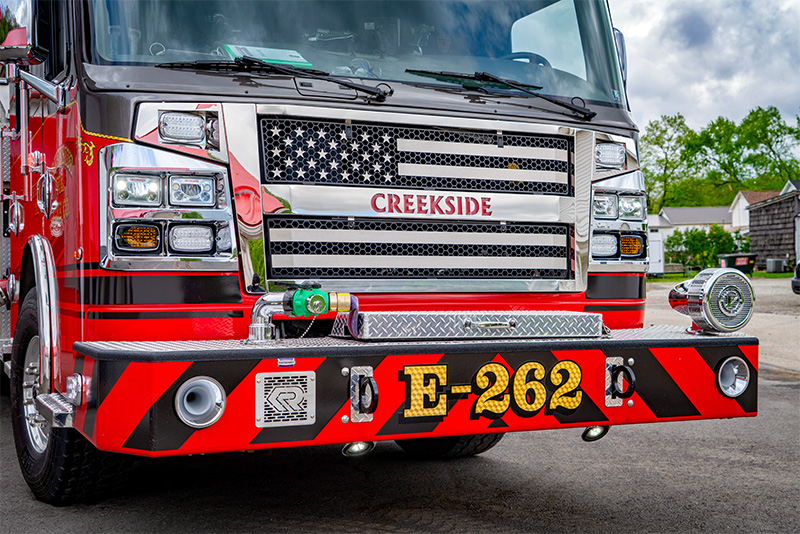
Rosenbauer Motors · Wyoming, MN 100% Rosenbauer America–owned
Plant / Commander chassis photo Rosenbauer Motors plant, Wyoming, MN
Configure the cab

Seven cab sizes. Five roofs.

Size the cab to your crew and your station — from a compact two-door to a full crew cab seating ten, with the roof height that clears your doors.

Cab size — cab-to-axle (CA)
33″ 2-Door45″54″60″65″70″78″

Cab size is given as cab-to-axle (CA) — the distance from the front hub centerline to the back wall of the cab. A longer CA seats more crew and adds wheelbase.

Roof height
Flat8″ Raised11″ Raised18″ Raised24″ Raised
Also your choice
Seating up to 10Full-length or barrier doorsRound or square headlightsHeated windshieldAluminum dash
Reference

Cab dimensions

Roof heights, frame height, approach angle and cab-to-axle — the Commander side elevation at a glance.

106.76″ FLAT-ROOF HEIGHTSIDE ELEVATION · FROM THE FACTORY DRAWING
Roof heights OVERALL, IN.
24″ Raised129.63″
18″ Raised123.63″
11″ Raised117.60″
8″ Raised114.60″
Flat Roof106.76″
Key dimensions
Cab-to-axle (CA)
45″ – 78″
Grille → front axle
79″
Frame height
40.29″
Rear floor / frame
8.28″
Front floor / frame
6.28″
Approach angle
45°
Cab-to-axle (CA) is the distance from the front hub centerline to the back wall of the cab — it is not cab width. A longer CA seats more crew and lengthens the wheelbase. Roof heights are actual overall heights; nominal callouts (8–24″) are rounded. Cab profile is the factory Commander dimensional drawing.
Under the cab

The engineering behind the ride

Beyond the crew-first features above — the chassis systems that decide how a Commander drives, stops and lasts.

01
Best-in-class maneuverability
A streamlined steering geometry delivers a certified 46° minimum cramp angle, left and right, on every axle and tire package — the same tight turning whatever you spec.
46° cramp · third-party certified
02
Rollover & impact protection
Optional RollTek side-roll protection tightens the belt and deploys a curtain in under 0.3 seconds, with frontal air bags available for the driver and officer.
RollTek · <0.3s deploy
03
Engine cooling
The engine sits low and rearward with ~11″ of fan-to-radiator space and a vertically-stacked charge-air cooler — efficient cooling even with the 600 HP Cummins.
Stacked charge-air · cools at 600 HP
04
Ride & suspension
Hendrickson multi-leaf spring to 22,800 lb, or independent front air suspension (IFS) to 24,000 lb on Bilstein gas shocks. We offer IFS too — ours rides like the competition’s but is built on serviceable, non-proprietary parts, so it doesn’t carry their maintenance bill.
IFS air 24k · non-proprietary
05
Electrical your way
Point-to-point wiring for simple troubleshooting, or the Rosenbauer LCS (Logic Control System) for programmable control and load management.
Point-to-point or LCS
06
Clean-air cab
An in-cab air-recirculation scrubber pulls carcinogenic particulates and VOCs from the cab — 50% VOC reduction in 2 minutes, 80% in 5. New builds or retrofit.
Clean Air · new or retrofit
See the Commander

Inside & out

Crew cab, dash and console, seating, structure and safety testing — the details that make the Commander a purpose-built fire chassis.

Photo 1 Color matching dash inserts based on cab paint color. 01
Color matching dash inserts based on cab paint color.
Photo 2 Tapered engine-tunnel for comfort. 02
Tapered engine-tunnel for comfort.
Photo 3 Flat front crew space, large enough to easily ride with turn-out boots on. 03
Flat front crew space, large enough to easily ride with turn-out boots on.
Photo 4 One piece windshield, no center post obscuring your vision. 04
One piece windshield, no center post obscuring your vision.
Photo 5 Quiet cab rider, have conversations without the need for in-cab radio headsets. 05
Quiet cab rider, have conversations without the need for in-cab radio headsets.
Photo 6 Havis-Shields Customizable Center Console 06
Havis-Shields Customizable Center Console
Photo 7 Spacious interior, comfortable for all crew members 07
Spacious interior, comfortable for all crew members
Photo 8 Wide chassis cab doors, allow safer egress with turnout gear and SCBA. 08
Wide chassis cab doors, allow safer egress with turnout gear and SCBA.
Photo 9 Crash tested by IMMI 09
Crash tested by IMMI
Photo 10 Driver and Officer airbag tested 10
Driver and Officer airbag tested
Photo 11 120,000# Roof crush test. 11
120,000# Roof crush test.
Photo 12 Rear flat floor space. 12
Rear flat floor space.
See it move

Commander in the field

Walkarounds and demonstrations — the cab, the chassis and the crew features in action.

Video
Video
Specifications

Commander vs Warrior spec sheet

Both custom chassis, side by side. The Commander carries the fuller option list; the Warrior covers the core at a value price.

SpecCommanderWarrior
Engine
Cummins X10, X12 or X15
Cummins X10
Horsepower
380 – 600 HP
380 – 450 HP
Torque
1,000 – 1,850 ft-lb
1,150 – 1,700 ft-lb
Transmission
Allison 3000, 4000 or 4500 EVS
Allison 3000 or 4000 EVS
Alternator
270 – 430 A · Leece-Neville, Delco Remy or Niehoff
270 – 430 A
Before you spec

Questions to ask yourselves

The answers to these shape the whole chassis. Work through them with your crew — we’ll steer you to the right Commander.

Match the engine to the truck's weight, your terrain and any pump. The Commander runs the Cummins X10, X12 or X15 — 380 to 600 HP; the Warrior runs the Cummins X10. A loaded tanker on hills wants more torque than a flat-ground pumper. Tell us the mission and we'll size it.
Crew size drives the cab size. The Commander comes in seven cab-to-axle (CA) sizes — from a 33″ two-door up to 78″ — seating up to ten. CA is measured from the front hub centerline to the back wall of the cab, so more seats and SCBA positions mean a longer cab, which adds wheelbase and affects overall length and turning.
Raised roofs (8″, 11″, 18″ or 24″) add headroom and interior space but raise overall height. If you have low station doors or route clearances, that trade-off matters — we'll spec a roof that fits.
Measure your lowest door and route clearances. Roof height, light towers and anything on top all count. A lot of older stations have 10-foot doors — tell us and we design to clear them.
Wheelbase, GVWR and axle ratings are set by your bays, bridges and posted roads. The Commander offers steer axles to 24k, drives to 35k and tandems to 63k — we spec the ratings to keep you legal and safe loaded.
For wildland, rural or off-pavement response, the Commander offers 4x4 via transfer case or power divider, Marmon-Herrington front axles and an EZ-Trac front-drive system. If you leave the pavement, tell us.
Point-to-point wiring is simple and easy to troubleshoot; the Rosenbauer LCS multiplex system adds programmable control and load management. We'll walk through which fits your department's service preferences.
Powder-coated rails and cross-members are standard. In coastal or heavy road-salt regions, hot-dip galvanizing adds the ultimate corrosion protection. Tell us your environment.
Independent front air suspension and an air-ride cab improve ride, handling and crew comfort on long or rough responses — both are options worth considering for high-mileage rigs.
Chassis and complete apparatus already in production can take months off your delivery. Ask us what's available currently and we'll send the list.
Get started

Let’s spec your Commander

Tell us the apparatus and your station’s limits and we’ll configure the chassis around it.